 Block Presence
Block Presence
Block Presence
This control element switches the presence, see also Presence general.
The Presence function is used to trigger certain functions when the presence changes. Here you can set on each control element what should happen on change. A distinction is made here between the three states Present, Absent and Holiday (long-term).
The control element is available in two different views, Block and Basic Screen. Depending on the design of the visualization, the element is displayed in the following two variants. In the footer, the switchover is displayed automatically when presence is used.
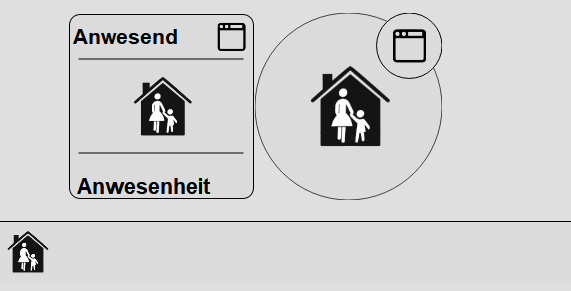
Clicking the element displays the following dialog:
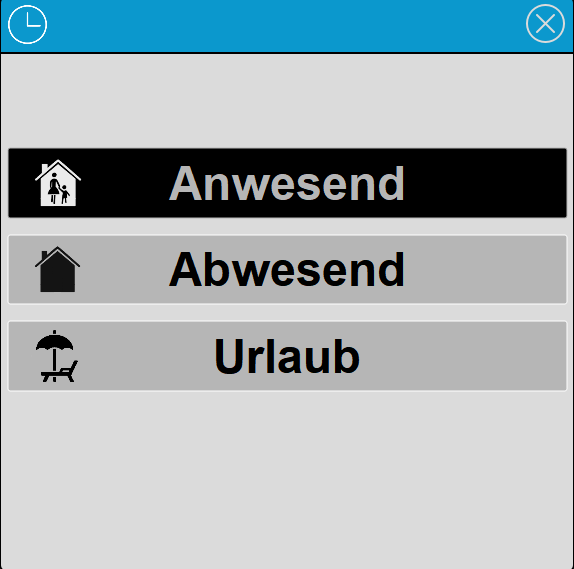
The button switches between the states Present, Absent and Holiday. All control elements that support presence then perform the configured actions. For example, when Absent all lights are switched off and the heating is lowered.
The time switch can be configured via the clock symbol in the title bar.

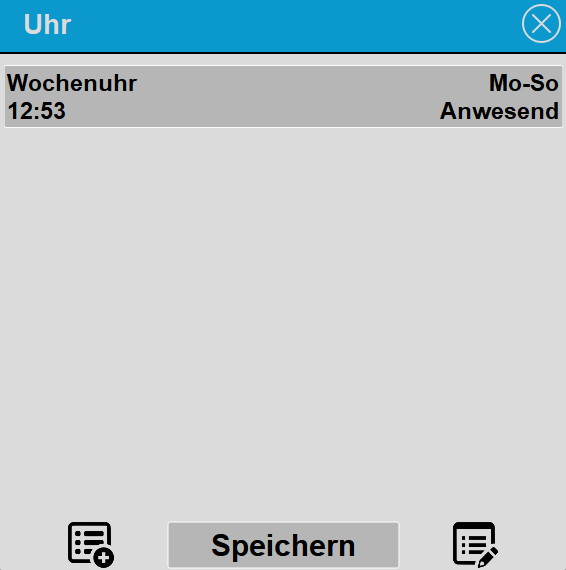
With the Time switch function, the lighting can be switched on a time-controlled basis. To add a new switching time, press the symbol at the bottom left; to delete switching times, click the symbol at the bottom right.
Using the calendar icon in the switching time list, switching times can be imported from a calendar file (iCal, *.ics) - via a link (including Google Calendar, Apple iCloud, Google Drive and Dropbox), from a file or from the clipboard. One on (value 1) and one off (value 0) switching time are created per event. For details on the import see Block Time switch; where to find the calendar links in the respective services is described in the help of the Holiday time clock.
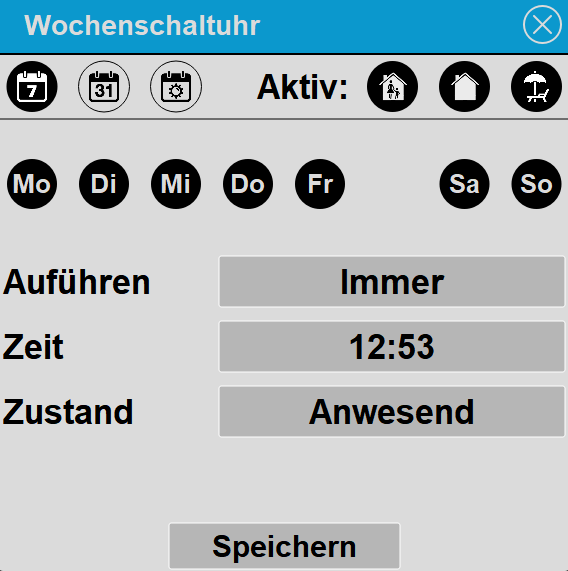
The first row shows the symbols for the type of clock and presence. On the left side the type of clock is set. As type you can select Week clock, Date and Sunrise/Sunset. On the right side you set when the clock should be active (dark background means active).
On the right side you set when the switching time should be active. Present, Absent and Holiday. This allows you, for example, to select that a switching time is only executed when you are present, but not when Absent or on Holiday. If none of the three symbols is active, the switching time is not executed; in the overview, Clock disabled is then displayed.
Under Execute you can select once or always. With once, the symbols Present, Absent and Holiday are deactivated again after execution and thus the switching time is also deactivated.
Display |
|
| Display | Display Block, Basic Screen or List. |
| Text | Text to be displayed. The size of the text is scaled automatically with the control element. Line breaks can be inserted with the special character "\n", for example "Line1\nLine2"; a maximum of 2 lines is possible. |
| Text Present | Alternative label for the state "Present", for example "Open" in a hotel. If the field is left empty, "Present" is displayed. |
| Text Absent | Alternative label for the state "Absent". If the field is left empty, "Absent" is displayed. |
| Text Holiday | Alternative label for the state "Holiday". If the field is left empty, "Holiday" is displayed. |
| The three labels apply to
the entire project: they are also used in the switch of the page
footer and in the time switch dialogs of the other block control
elements. If a project contains several of these control elements,
the texts of the one created first apply. The icons remain
unchanged. |
|
| Tip: If
the Background parameter is not selected under Transparency settings,
only the icon is displayed. This allows the
element to be placed more easily over another element, for
example. |
|
Connected variablessee function block Structured Block Presence |
|